

It’s 4:45 p.m. on the second Monday of the month, your board’s standing executive session. You have 15 minutes before the call to open the packet you were sent on Friday — 100+ pages of manager reports, minutes, vendor proposals, bid-leveling tables, and financial data. You find yourself wishing for an Executive Summary and skim what you can.
The agenda appears to run in the order items arrived, not in an order that reflects what matters. Two-and-a-half hours later, you’re 15 minutes past the meeting’s scheduled end, one of your fellow board members has to play a softball game, and the discussion never reached the one item that needed a decision.
That isn’t an unusual meeting. It’s what happens when smart, busy people are moving too quickly to see clearly.
A project stalls, and nobody can say exactly why. The same disagreement makes it to the agenda for the sixth consecutive month, and the volunteer who kept raising it stops showing up to argue it — not because it stopped mattering, but because it stopped feeling worth the fight.
An owner or association member asks a straightforward question, explaining that they’ve received three different answers from three different people, none of them clear, none of them the same, and they’re asking for the “real answer.”
A committee member spends a weekend on a proposal, submits it for board review, and gets a one-line reply three weeks later: “Not now.” No reason given. And they’re no longer willing to help.
These don’t feel connected. They feel like unrelated situations — a stalled project here, a discouraged volunteer there, an unanswered question somewhere else. But the conditions that produce them are usually the same, expressing themselves in different ways.
Nobody handed them the map.
Board members have significant responsibility yet often lack a view of the entire system they’ve been asked to lead. They receive governing documents, budgets, statutes, and reports from professionals who each know their piece well. What they don’t receive is anything resembling a map showing how it is all supposed to work together. They’re assembling puzzle pieces without the benefit of seeing the picture on the box. So problems get treated one at a time, as they surface, instead of at the source, ensuring they return cloaked as something different. Rinse and repeat.
Board members are volunteers. They serve while having full lives, limited time, and meetings that are just two more hours wedged into an already full week or month. Overseeing an organization with dozens of stakeholders is hard enough. Leading it when you don’t know what you don’t know — and aren’t even sure of the end-game — makes it even harder.
BoardOS serves as a general map for volunteer board members: a practical way of viewing the organizations they lead that helps ordinary people carry an unusually broad responsibility with more clarity and less unnecessary friction.
Property managers, attorneys, engineers, reserve specialists, accountants, and insurance professionals each serve an important, specific purpose. Their scopes are supposed to be narrow — that’s what makes their expertise valuable in the first place.
The board’s job is different. It doesn’t need to master every discipline it hires, nor can it. Instead, it needs to ask useful questions, recognize when an issue crosses more than one discipline, and keep information moving among the people responsible for each piece. Hiring a professional transfers the work. It doesn’t eliminate the board’s responsibility to oversee it and make the decisions reserved to it.
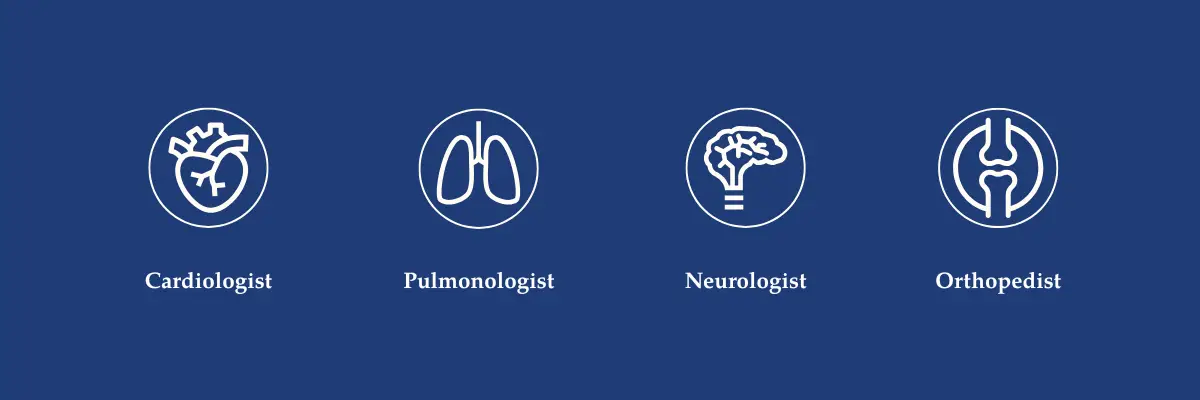
That’s where many recurring problems begin. Picture four medical specialists examining the same patient — a cardiologist, a pulmonologist, a neurologist, and an orthopedic surgeon. Each one runs his or her tests. Each one diagnoses something real. Each one treats it correctly, by every standard of their own specialty. And the patient keeps coming back because nobody is comparing notes, and nobody owns the whole picture — only a piece of it. That isn’t a medical failure. It’s a coordination failure, and it shows up in building maintenance with the same regularity it shows up in medicine.
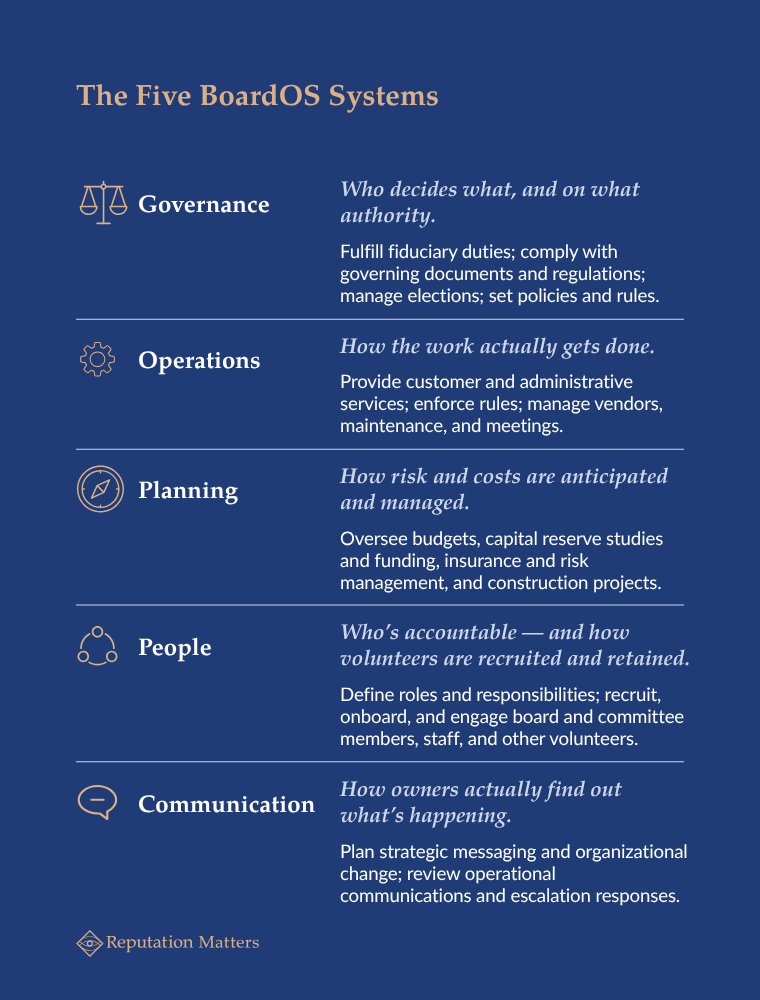
BoardOS uses five terms — Governance, Operations, Planning, People, and Communication — as a cohesive way to understand how a board’s work fits together.
It comes from hard-won experience: 12 years running a condo board, 16 if you count committee service, across two very different kinds of transitions — a developer handing board control to owners, and individual board members handing the reins to their successors — as well as hiring a new property management company to succeed the developer’s incumbent.
What that experience surfaced, again and again, was how much different work — planning, continuity, communication — falls into a single de facto miscellaneous category, labeled “governance,” simply because there’s no other category for it.
BoardOS first describes how volunteer boards operate, the systems needed for boards to thrive instead of just survive. That’s different from other frameworks for organizations serving community associations, direct-service nonprofits, civic organizations, and historical or neighborhood clubs.
BoardOS then organizes work, connecting similar tasks and separating those that require different thinking, regardless of who’s tasked with doing them. It helps boards see what must be prioritized, connected, delegated, and brought back for judgment.
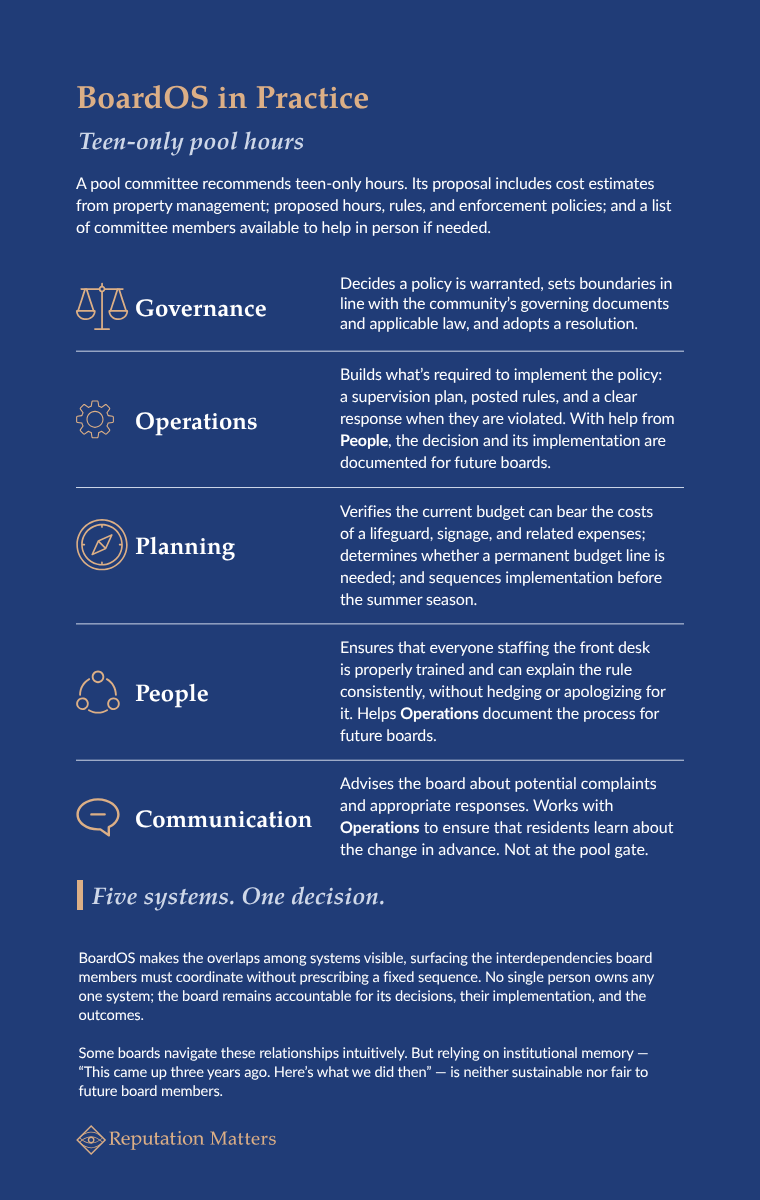
The result: BoardOS sheds light on the gaps and overlaps among systems, making them visible, surfacing the interdependencies board members must coordinate without prescribing a fixed sequence. No one person carries an entire system alone; the board remains accountable for its decisions, their implementation, and the outcomes.
Professionals and technical specialists, in contrast, work within their defined scopes of work — which is exactly why the gaps among those scopes are the board’s to close, meaning they have to do it themselves, expressly delegate it to someone else, or hire another third party for that work to be done.
The trap is assuming those board-level systems are covered because specialists are involved. They often aren’t. That is how a board can make a decision without knowing all it requires — only to discover the missing requirement when it becomes a near crisis.
Some boards navigate these relationships intuitively. But relying on institutional memory — “This came up three years ago. Here’s what we did then” — is neither sustainable, fair, nor perhaps even relevant to future board members.
The board’s system of authority and judgment: deciding what matters now versus what can legitimately wait, setting policy, assigning authority, and maintaining responsibility for the whole — not just certain parts.
In governance mode, a board prioritizes what requires its immediate attention and what can wait — not because lower-priority needs don’t matter, but because a board that tries to do everything ends up doing nothing.
Boards are not governing when they allow recurring complaints to dominate meetings. They are not governing when they insert themselves into daily operations, micromanage paid employees, permit risk-averse professional managers to defer operational decisions to the board, or fail to verify delegated work is completed by agreed deadlines.
In contrast, boards are governing when they address an engineer’s structural integrity finding, make difficult capital reserve funding decisions, focus on anything related to the community’s long-term value, and supervise the professionals they employ.
Boards are also governing when they adopt resolutions that keep recurring complaints from repeatedly pulling them away from decisions that only the board can make. That may seem excessive, but a clear resolution can authorize a manager or standing board-sponsored committee to handle routine follow-through, and reduce repeated demands for similar matters to return to “the board.”
More importantly, board members who allow operational decisions or recurring complaints to dominate their time are doing both their communities and themselves a tremendous disservice. And they risk deferring an important decision or missing a regulatory requirement that has a much longer shadow than an operational matter the manager or a committee can handle in their stead.
Governance is the layer on which every other system depends, and it’s usually the least glamorous, most avoided part of the job — which is exactly why boards under-invest in it.
The repeatable work system through which board decisions become standard operating procedures, including workflows, handoffs, standards, vendor and management coordination, escalation, and follow-through.
Translating board decisions into daily practice is rarely as simple as handing down a rule and moving on. A single policy decision can require staffing coverage, updated rules, a consistent enforcement standard, staff and volunteer training, and a clear path for escalating anything that falls outside what’s already been decided. Operations is the system responsible for identifying — and building — everything a decision requires before it can be implemented successfully.
Beyond turning board decisions into actions, operations covers the daily work of running a building, community, or volunteer-led organization: overseeing service requests, rules enforcement, and routine administrative work, as well as managing maintenance staff and vendors. It also covers more technical procurement work — developing requests for proposals, leveling bids, and supporting the board’s contract-selection process — plus supporting committees and taking on ad hoc projects when a manager’s existing contract and capacity allow for it.
While every role, volunteer or paid, is demanding, property managers oversee a diverse portfolio of specialties and tasks. That, combined with customer service and unpredictable incidents, makes their roles more reactive than many people would like. Depending on a community’s specific needs, supplemental construction or project management services may be necessary for planned and unplanned capital projects.
The tighter and more predictable a board’s own operations are, the less it needs to lean on supplemental services to fill the gaps — and the less it pays, later, for help it could have avoided needing in the first place.
The forward-looking system for seeing what’s coming, making choices early, sequencing the required work, and aligning timing, money, information, and capacity before a matter becomes urgent.
When a board knows 18 months out that an elevator will need replacing, planning turns that knowledge into a funded, sequenced project — specs, bids, resourcing, timeline — instead of a surprise special assessment. The same discipline applies when a civic or nonprofit board turns an anticipated program, staffing, or fundraising need into a funded plan before it becomes an emergency.
Planning doesn’t necessarily do all the work itself; Operations is responsible for execution. But Planning’s purpose is to make sure the work is anticipated, sequenced, and funded well before it becomes urgent — including setting aside funds for supplemental construction or project management when a stretched operations manager can’t reasonably take on complex projects alongside everything else.
Finally, Planning has oversight for budgets, capital reserve studies, contribution amounts, and prioritization of large-scale improvements and ongoing maintenance. Given the rising cost of insurance and increasing scrutiny from regulators and lenders around structural integrity and risk management, boards increasingly find that planning decisions cross professional boundaries — reserve funding touches insurance, insurance touches mortgage eligibility, and few decisions stay within any one specialist’s area of expertise.
The human-capacity and continuity system: giving everyone who speaks for the board — board members, staff, and resident-facing staff alike — the standing, training, and continuity to answer consistently and carry institutional knowledge through turnover.
People — employees, volunteers, members, and the people who speak for the organization — are the heart and soul of any volunteer-led board’s work. Everything they do cultivates the culture, character, and cohesion that distinguishes one community association from another.
The People system is what makes rules withstand challenges and foster productive conversations — the training and the script all employees need to respond definitively, from the staff and member-facing representatives to volunteers, every time, regardless of who’s asking. It also facilitates more effective Governance by retaining crucial knowledge that future boards may need when a veteran board member’s term ends and leadership passes to other people.
In a traditional organization, its “People” function, often called human resources, or HR, is limited to its employees. That is true for managers who directly manage administrative, maintenance, security, cleaning, and other specialists. That’s one reason why boards outsource specific services: to reduce the costs and time required for direct management of large teams.
The People system for volunteer-led boards and organizations, however, includes additional — and vital — human resources: volunteers. If people in general are the heart and soul of an association, volunteers are the lifeblood of thriving communities. It’s vital to engage future board leaders, committee members, and volunteers in the Governance and Operations of community associations, few of which have the financial resources to hire experts to handle everything a diverse community needs and expects.
The shared understanding system: explaining decisions, setting expectations, preparing owners, members, and staff for what is changing, and making clear what’s known, what’s not yet known, and what comes next.
Communication, as a system, is both the connective tissue and the neural network of a community. It is, unfortunately, misunderstood and frequently treated as an afterthought, such as in the case of a long-stalled controversial policy finally getting approval the day before, and the board expects it to be the centerpiece of an otherwise finished newsletter that’s queued up to send. Or when a social event for which no one thought to send a “save the date” or formal invitations with RSVPs suddenly becomes a fire drill because the caterer needs food counts in three days.
Good Communication is highly strategic, meant to preempt complaints about that controversial policy that derails board business for months, or to sell out tickets and raise much-needed supplemental funds at that event to revive a community garden.
Good Communication anticipates resistance and takes it into account as decisions are being made — not after — and as individual communications, such as posts, emails, and other messages, are being developed.
Good Communication takes place where people are, not where boards expect or want it to happen.
Good Communication happens in the most unexpected places; it could be your receptionist or a porter, someone people turn to for answers, who is not prone to gossip or rumor. Your spokesperson can be anyone who’s trusted by your community and whom you trust to keep people informed. You just need to tell them the fact and let them do their thing.
Good communication is comprehensive and repetitive. It requires effort and forethought. It’s never one-and-done.
Only by understanding those and other factors — resistance, location, “spokespeople” — can good Communication take place. The only practical test of good Communication is whether the intended audience does what the communication asks or enables them to do — not whether a newsletter earned clicks or a message sparked parking-lot conversation. When someone listens instead of yelling, asks a question instead of assuming, agrees to disagree, boards have communicated. Full stop.
The most basic, yet most effective, pieces of advice are:
When costly legislation is being debated, start talking about it, speak about it often, and respond confidently. The worst that can happen is the bill is quashed after you’ve caused unnecessary concern; even then you can say, “We dodged a bullet. That punitive bill failed. The good news is we can now use the money we were holding for unplanned inspections and begin the next round of preventive maintenance six months earlier.”
Boards see symptoms first.
A meeting feels unproductive. A complaint won’t go away. A project seems to be moving, but nobody can say who’s waiting on whom. Those symptoms are real, but they don’t always point to where the problem started.
A planning decision that’s never explained can surface later as a communication problem. A Governance decision that’s never translated into a clear process can show up as Operational friction. A continuity gap can cause a board to reopen a decision because the reasoning behind it never survived the last round of turnover.
When boards see the symptoms as patterns, there is no shortage of questions. It’s easy to jump to “What’s broken?” The better question is “What relationship among systems broke down before it was discovered?”
Systemic problems are rarely simple, and few boards ever get past the surface to the root. They see the failure, treat the failure, and assume it’s “fixed,” rarely realizing they may need to get their head fully under the water, look at what’s connected, and identify what’s actually causing it: the root problem.
Systemic problems are rarely simple. Few boards get past the surface to the root.
This is what a recurring repair usually looks like from the inside.
Someone calls about a leak. The person logging the complaint writes down what they were told, without ever seeing the location themselves. The work order goes to the maintenance team, who diagnose what is directly in front of them and call the right tradesperson. The vendor fixes exactly what they were called to fix.
At no point does anyone step back and ask what else is connected to it. That’s not negligence — it’s specialization doing exactly what specialization does, narrowing focus to work efficiently within a defined scope. The problem is that nobody in that chain owns the full system.
One board learned this the expensive way with a recurring HVAC failure. A repair to a rooftop condenser worked for a few weeks before failing again.
An independent architect, finally brought in to look at everything nearby rather than just the failing unit, traced it back to a roof replacement three years earlier that had unintentionally changed how water drained near the condenser. Instead of flowing toward a drain, water pooled beneath the unit. During heavy rains, water short-circuited the condenser’s capacitors, causing it to stop working.
That’s not a contractor failure. That’s a scope failure, and within BoardOS, scope is a Governance responsibility.
Until the architect was engaged, nobody connected those two systems — not when the roof was replaced, nor when they were trying to figure out why the capacitors short-circuited — not because anyone was careless, but because it wasn’t anybody’s job to do.
There’s a shorthand for what happens when nobody owns that scope: four-finger caulking — wide, uneven masses of sealant applied in layers over years of quick fixes, each one covering the last without addressing what’s underneath. It’s ugly, but it works, until it doesn’t. And when it fails, the repair bill reflects not just the current problem but every previous fix that never solved anything.
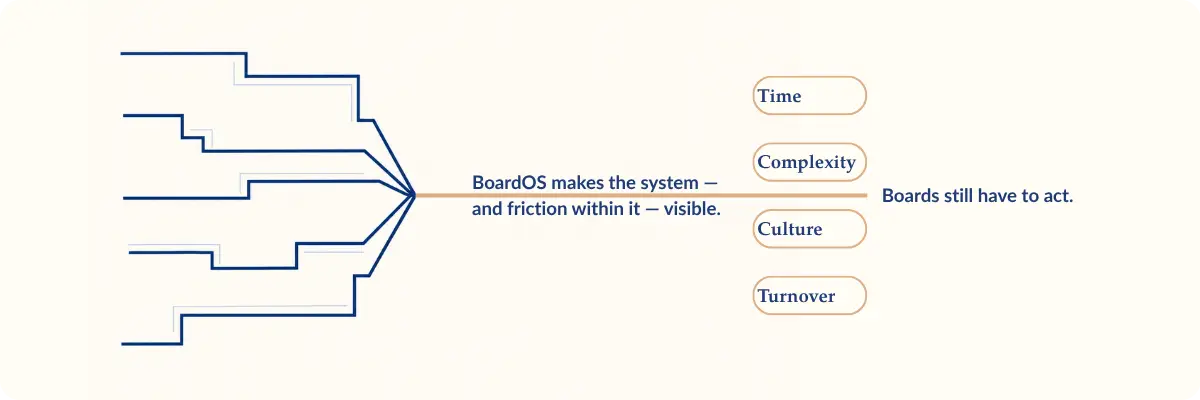
“Nobody showed them the map” is true, but it isn’t the whole story either.
Understanding BoardOS’ five systems helps, but boards can understand their roles completely and still get stuck, because training only solves some gaps, not all of them.
Time is real: Board members fit volunteer service around jobs, families, and the rest of their lives, not instead of them.
Complexity is real: The responsibilities boards carry today — regulatory requirements, fiduciary duties, financial oversight, capital projects — are heavier than they were even a few years ago.
Culture is real: Some boards work through disagreement productively, and some don’t, and that has little to do with whether anyone read the bylaws.
Turnover is real: Even boards that build genuine clarity can lose it in a single election cycle if the reasoning behind past decisions never reached the people who inherit them.
The map still matters — but on its own, it isn’t enough to hold up under pressure, time constraints, and personalities.
That’s why BoardOS pairs its five-system model with corresponding workflows and processes — establishing clear authority, workable handoffs, continuity practices, decision routines, and communication pathways — rather than treating education alone as the fix.
Understanding the five systems helps, but boards can understand their roles completely and still get stuck.
The psychoanalyst Donald Winnicott spent decades studying what children need from parents and found it wasn’t perfection. His argument wasn’t that parents should aim low. It was that children don’t need someone who never fails them — just someone who shows up consistently, tells the truth even when it’s uncomfortable, and starts the hard conversation before certainty arrives, not after. Winnicott called that being “good enough.”
The same standard applies to a board. People don’t need a board to have every answer. They need one willing to say what’s known, what isn’t yet, and what happens next — before the silence does the talking for them.
That’s what good enough looks like in practice. It’s not perfect. It’s honest, consistent, and early. And it’s enough.
Board consulting begins with the board’s actual situation — a decision that will not move, a project that has stalled, or a relationship that needs repair. This video explains how the work takes shape.
BoardOS itself isn’t a step to complete. It’s the lens through which diagnosis, problem-solving, and implementation all pass.
Diagnosis starts with an honest admission. “We don’t know. Yet.” That’s not a weakness in the board. It’s the reason a structured analysis is needed.
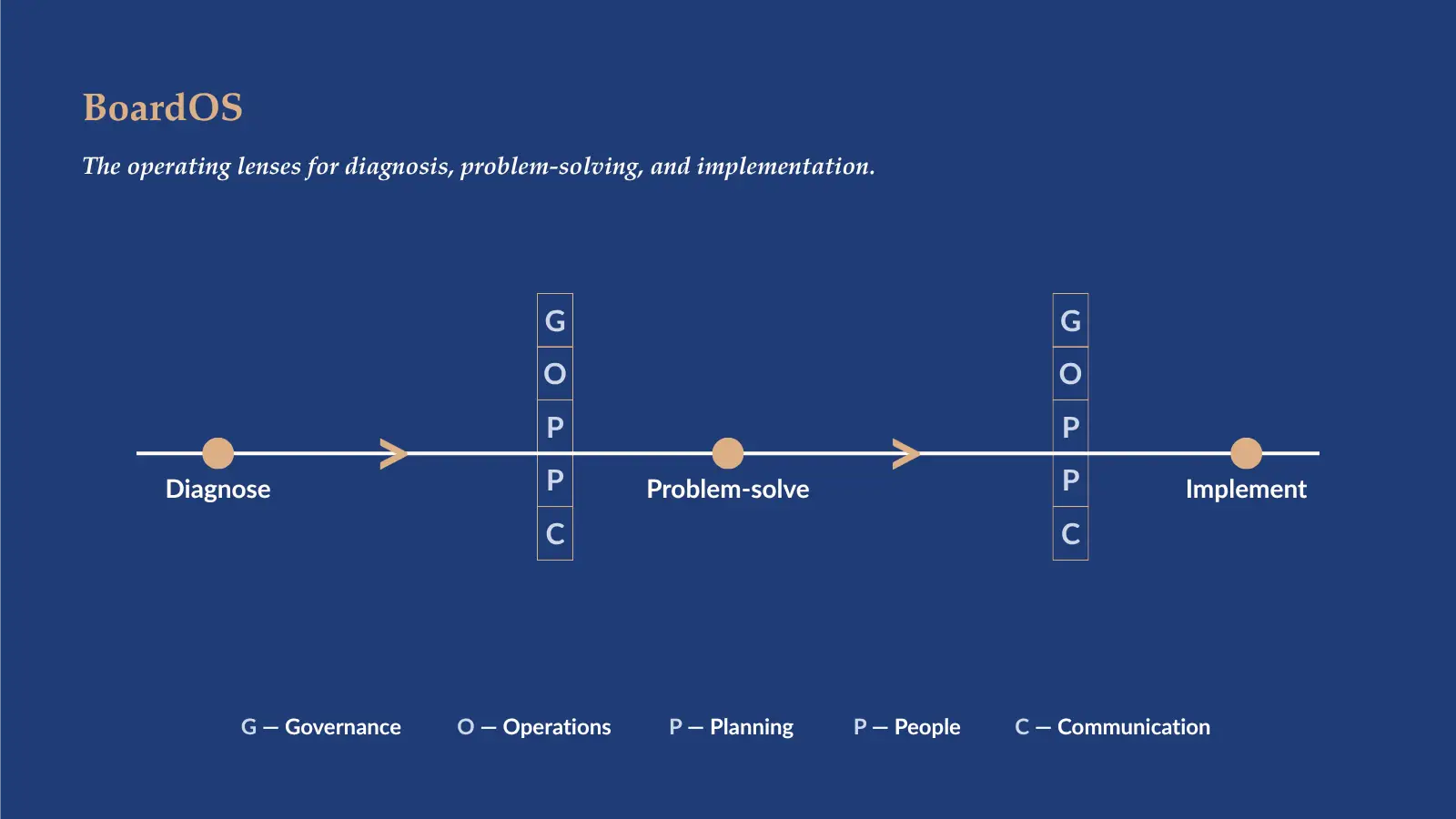
Sometimes a formal process is useful. The Boards That Thrive Diagnostic examines Governance, Operations, Planning, People, and Communication through a scored 50-question, 250-point framework, which helps a board identify its own patterns, interdependencies, and a clear sequence for addressing priorities.
Boards don’t need to begin with a formal diagnostic when one’s not feasible or warranted. A focused conversation, a look at an active issue, or a short set of the right questions can often reveal enough to identify where work is getting stuck.
The point is to ask questions, examine the situation from various angles, look past the obvious to what’s truly hidden or hidden in plain sight; to consider what’s implausible and unlikely before making assumptions, before unwittingly prioritizing speed over quality, performance over permanence.
Bespoke consulting applies the BoardOS model to the board’s actual, underlying situation — the decision that needs to be made, the relationship that needs repair, the project that needs to move, or the communication that needs structure.
However, few solutions need to be built from scratch. Most board consulting engagements benefit from existing BoardOS-based programs that address common board challenges and can be implemented with or without ongoing support. The aim is always the same: Put better, more efficient ways of working into practice for volunteer boards at the lowest possible cost.
A well-run board doesn’t try to do every task itself. It builds clear processes, works with the right professionals, and hands off routine work to where it belongs, protecting its own time and attention for the decisions that require its judgment.
Take a recurring disagreement over an amenity rule.
Once the board has identified the issue and passed a resolution, the next step matters as much as the decision itself: A well-run board memorializes that resolution in a public open meeting, stating plainly what was decided, what it means, and that related disputes going forward will be handled by a defined process rather than reopened at every meeting.
The board then establishes a committee with a clearly defined scope — what the committee can handle on its own, what it must bring back to the board, and what remains beyond its authority — and delegates the ongoing work of enforcement and routine follow-through.
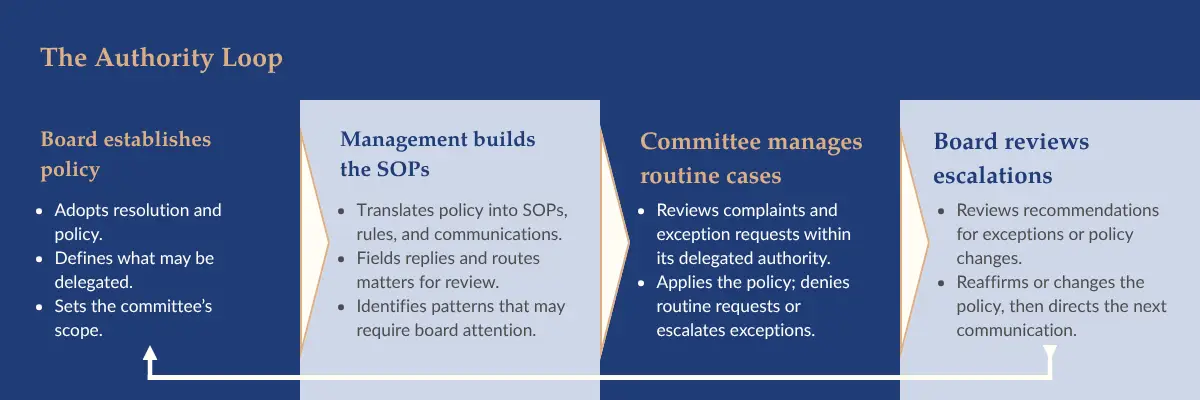
The committee, or whoever is tasked to handle it, can explain the rule, document the concern, resolve routine matters, or escalate legitimate requests for consideration, preventing routine disagreement from consuming every meeting going forward.
That’s not the board abdicating its responsibilities. The board remains accountable for the rule, oversight of the process, and the decision to revisit it if circumstances change.
Board time is finite. A board that keeps reopening its own already settled, routine matters has less time left for the work that can’t be handled through a simple process: long-range planning, major projects, transitions, and the decisions that shape where the community is headed.
The Boards That Thrive Diagnostic is the formal expression of BoardOS: a 250-point diagnostic with 50 points across each of the five systems, making the model visible and workable through:
A formal diagnostic is one structured way to begin. It isn’t the only way, and it isn’t a required first step before Board Consulting can help.
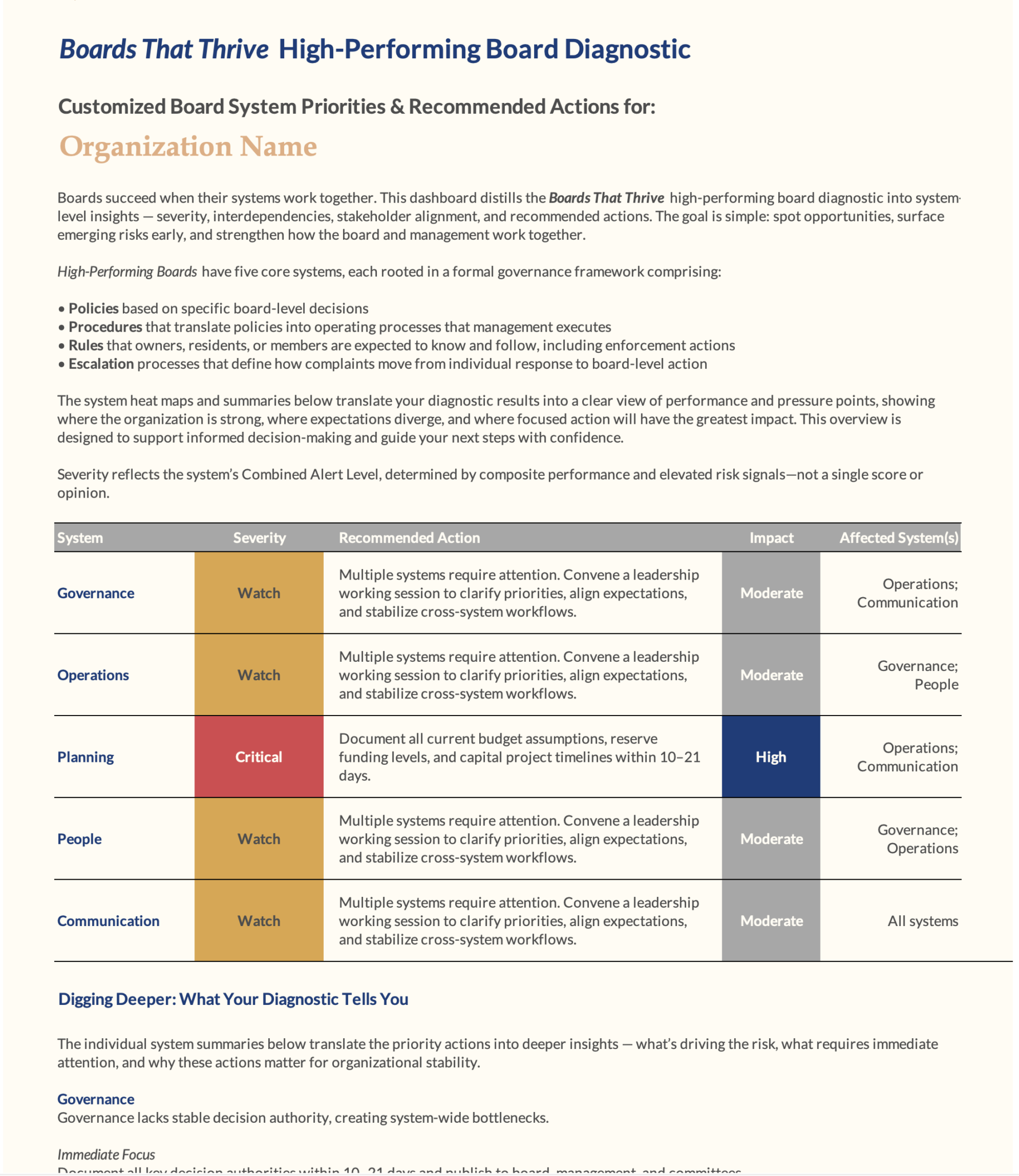
Programs are reusable, actionable ways of putting BoardOS into practice. They are practical resources a board can pick up and use for recurring challenges.
The Well-Run Building is the first. Currently, it gives boards a structured way to communicate complex, interconnected information to owners over time: structural integrity, reserve funding, and mortgage eligibility, as well as the fiduciary decisions and communication those issues require.
Active: structural integrity, reserve funding, mortgage eligibility
Future program
Future program.
Use independently • License • Implement with support
BoardOS doesn’t replace legal counsel, property management, engineering, reserve analysis, accounting, or insurance advice.
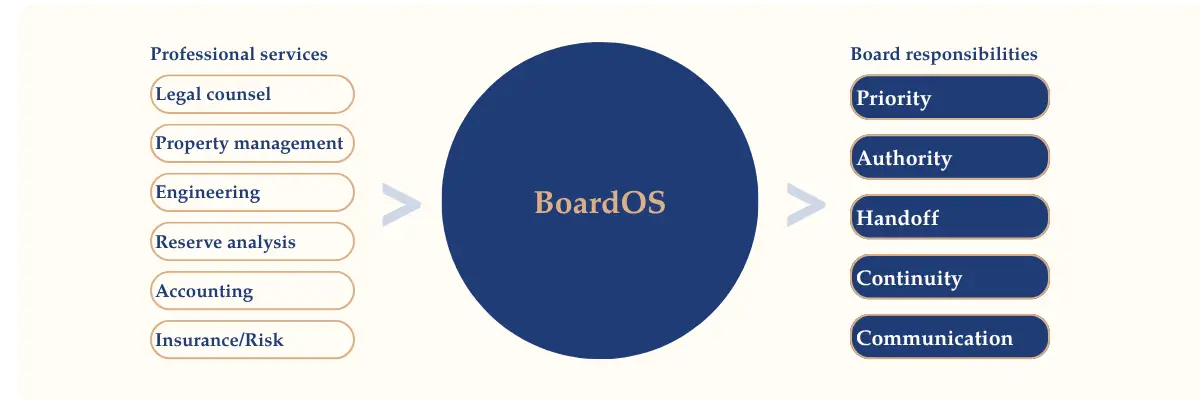
It helps a board use that expertise with more intention: clarifying what needs a decision, what can be delegated, what information needs to keep moving, and what has to be communicated before moving to the next step.
It gives a board a way to think across the whole system, without asking volunteers to become specialists in every part of it.
For 12 years, I served as board president of a condominium community with 450+ units in five historic buildings. I lived through capital repairs, vendor disputes, resident conflicts, budget pressures, and a developer transition dispute that remains in litigation today.
Nobody handed me a map. I learned the five systems the way most board members do: through trial and error, discovering all the things I didn’t know I didn’t know, one expensive lesson at a time.
BoardOS is the map I wish I had on day one.
Start with the lessons that had the greatest impact over 12 years of board service.
Board consulting rooted in BoardOS — whether through the Boards That Thrive Diagnostic, a program like The Well-Run Building, or a bespoke engagement — can help board members move more quickly through the steep learning curve of their early months and years of service.
I can’t promise to teach in 12 weeks what took me 12 years to learn. But I can share the lessons and approach to problem-solving that consistently had the greatest impact.
BoardOS gives new and experienced board members a way to lead, think, anticipate, and manage their organizations, communities, and shared assets with greater clarity. It is a framework for becoming the steward your community needs, expects, and deserves — while setting boundaries that help the board use its time well and reduce burnout.
No. BoardOS doesn’t do a property manager’s job, and it isn’t meant to.
It helps the board make better use of the professionals it already has, including its manager, by clarifying what needs a board decision, what can be delegated, and where information needs to keep moving.
No. BoardOS is the underlying way of seeing how a board operates.
Boards That Thrive is one formal way to make that visible: a structured diagnostic.
You can apply the thinking without ever conducting the diagnostic, and you can conduct the diagnostic without needing a full consulting engagement afterward.
No. A formal diagnostic is useful when a board wants a structured, scored picture of where it stands. It isn’t a required first step.
Many engagements start with a conversation about what’s actually stuck, not a scorecard.
Yes, arguably more so.
The best time to build clear systems is before pressure forces it.
Boards that wait until something breaks usually end up building the same structure anyway, just under more challenging conditions.
Continue with long-form articles on reserve funding, special assessments, mortgage eligibility, and the decisions facing condominium and community association boards.
The Well-Run Building is a program for boards that need to communicate significant, interconnected issues clearly and over time, before uncertainty turns into unnecessary distrust.
Board Consulting helps boards clarify decisions, responsibilities, priorities, and the systems needed to move difficult work forward.
You don’t need to have the answer before we talk.