
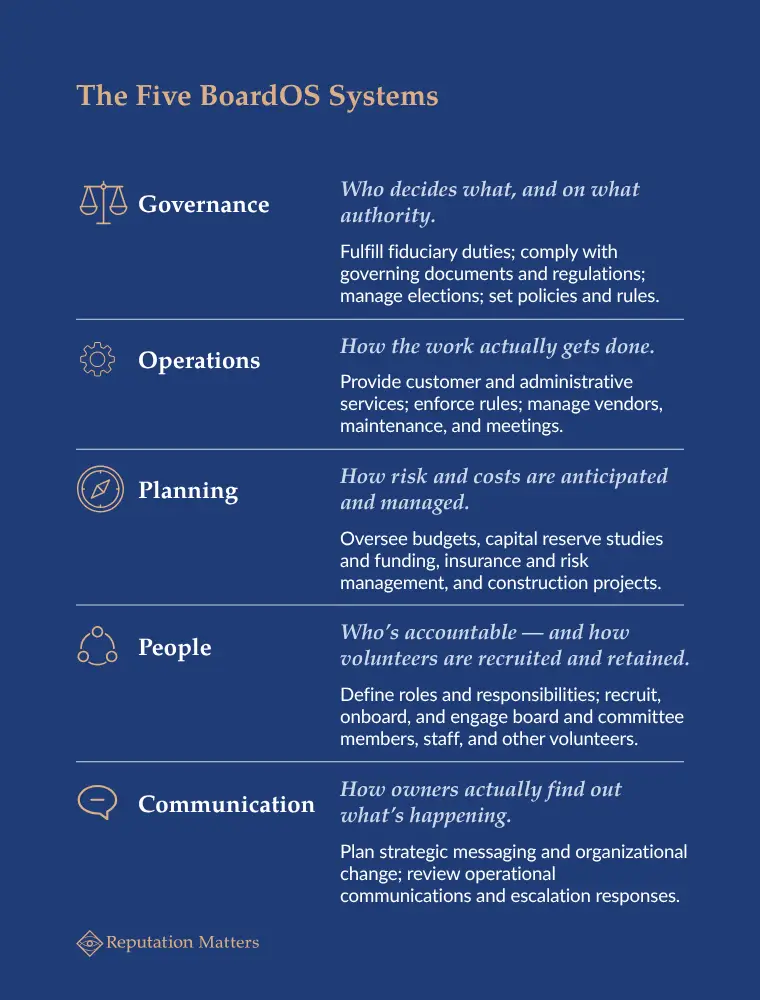
BoardOS is the model: five systems — Governance, Operations, Planning, People, and Communication — that describe how a volunteer board’s work actually fits together.
The Boards That Thrive Diagnostic is one way to make that model visible and workable, not the only way to begin, and not a requirement before Board Consulting can help.
The diagnostic scores each of BoardOS’s five systems on a scale of 1–5, with each system having 50 points, for a total possible score of 250 points. Each system and what it covers follow:
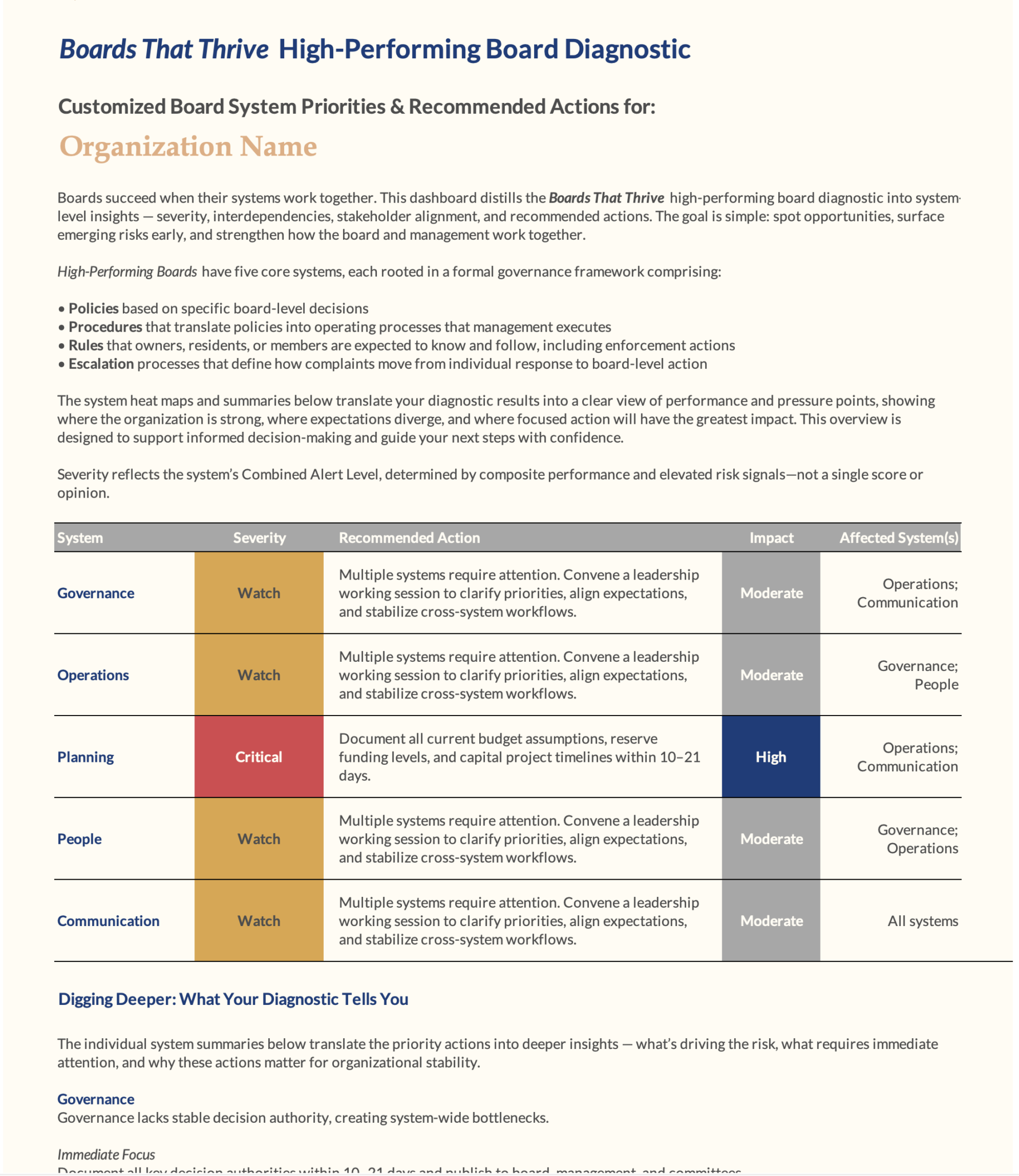
Individual board members, full boards, and property managers can each complete it independently. Comparing responses across roles often reveals more than any single score does — a wide gap between what a board believes and what its property manager sees is frequently the clearest signal of where unexpressed friction exists. A companion tabulation tool compares results across respondents and highlights where perceptions diverge most.
The result isn’t a grade or a verdict. It’s a clear view of which system needs attention first, and a short, specific list of actions that can be taken to address it.
Some boards prefer to conduct the diagnostic themselves. Others want help.
For boards that want guidance, there are generally three ways to use the diagnostic:
One board spent 12 weeks preparing owners before the number became official. The other waited for a complete answer. Only one kept its owners’ trust.
The diagnostic doesn’t promise a board will thrive — no assessment can guarantee that. What it can do is show, clearly and specifically, where a board’s five systems stand today, so the board decides what to do next with its eyes open, not in the dark.
You don’t need to have the answer before we talk.
Reserve funding is one part of a larger governance challenge. Structural integrity, mortgage eligibility, and the systems boards use to turn professional advice into decisions are increasingly connected.
Continue with long-form articles on reserve funding, special assessments, mortgage eligibility, and the decisions facing condominium and community association boards.
The Well-Run Building is a free program to help condo, co-op, and HOA boards explain structural integrity, reserve funding, and mortgage eligibility before crisis communication is needed.
Board Consulting helps boards clarify decisions, responsibilities, priorities, and the systems needed to move difficult work forward.